AI moves in-house and starts finding the holes
By Stefan Schmitt · 2026-11-18
Two things came together in AI over the last few weeks that change how I would plan the next year of building software. I posted about each on LinkedIn; this is the longer version, with the sources and the numbers in one place.
Companies can now keep near-frontier AI in-house
Until recently, the strongest models sat with outside providers. If your work involved client information you could not send out, you either settled for a weaker model you could host yourself or left AI out of that part of the work.
That gap has narrowed. Moonshot and Mistral released the weights of their flagship models, so a company can run them on its own systems, and Tencent said on 4 November that its own would follow. According to one report, Moonshot's model scored above OpenAI's GPT-6 Astra on an agent test of professional tasks, though the report names no outside tester. Running models of this size in-house still takes serious hardware.
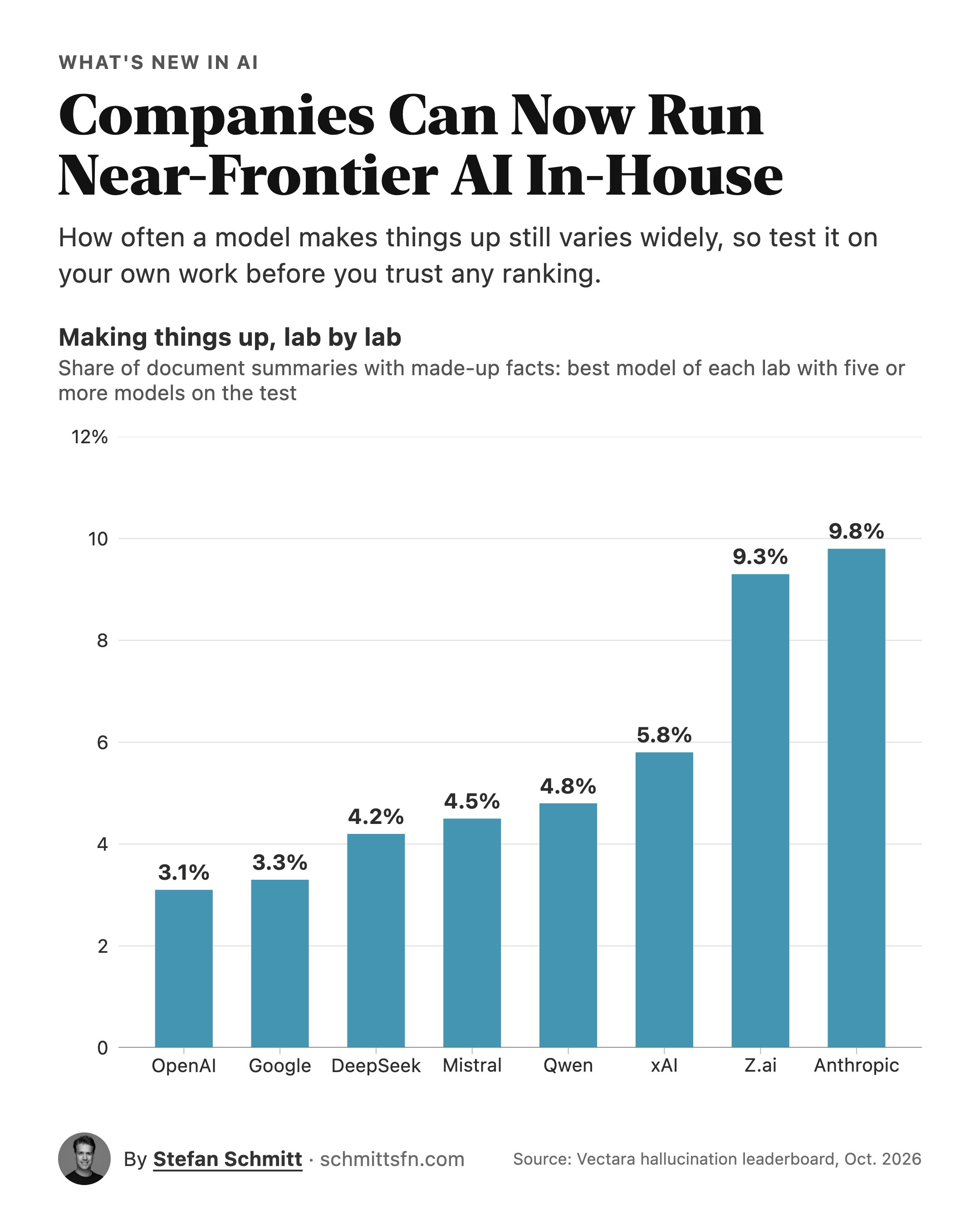
Running a model yourself only helps if it stays accurate, and there the evidence is mixed. Vectara's hallucination leaderboard has models summarize documents and uses an automated checker to flag claims the document does not support. Some older or smaller open-weight models make things up in about 4% of summaries, close to the lowest closed-model rates of about 3%, which also come from small models. Leading models tend to score worse, open or closed: Moonshot's three earlier Kimi models on the board land between about 11% and 18%, and closed models such as GPT-6 Astra and Claude Opus 5.5 sit near 9% to 10%. The board, last updated on 22 October, does not list the new releases yet.
So no ranking settles it for the model you would actually run. If I were choosing for a team, I would start small: run two or three of these models on last quarter's real client questions and compare the answers side by side. That tells you more than any leaderboard.
AI is finding the holes in iPhone software
The second shift is in security. Researchers using OpenAI's security AI found dozens of flaws in iPhone and Mac software, Forbes reported on 17 November, and the security firm involved says Apple has already fixed many of them.
I wanted to know whether that was a one-off, so I went through Apple's security notes for every iPhone update released this year and counted the fixes whose credit names OpenAI or Anthropic. The first four months had none. The first three fixes shipped on 11 May, and by the October update the total had reached 26. Most of those credits name the labs' AI tools directly, such as "OpenAI Codex Security" or a researcher working "with Claude", and Apple marks none of the 26 as exploited.
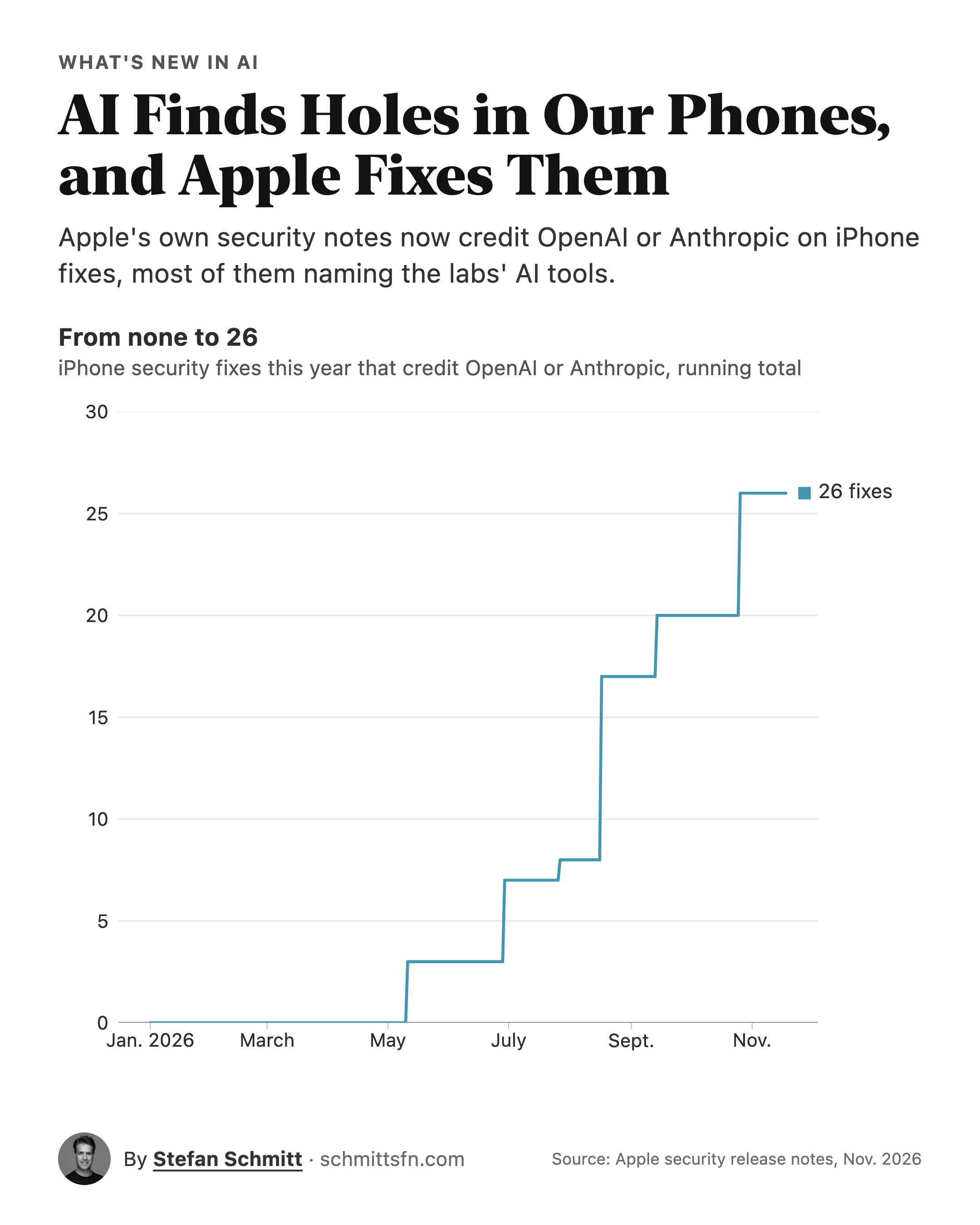
It is still a small share: 26 of the 697 vulnerabilities fixed across this year's iPhone updates. As I read it, though, hard work that used to take a rare specialist is increasingly done with tools, with specialists still in charge.
For anyone who ships an app, the practical step is simple. Let an AI look for holes before each release, keep a person in charge of what it finds, and treat its findings like any other bug report. And install your own updates the day they arrive.
What it amounts to
None of this makes the big AI providers obsolete, and attackers can use AI too. But I think both shifts give builders more control: over where their data goes, and over finding the holes in their own software first.
What's next
If this sort of note is useful, the newsletter is the best way to catch the next one.