Generative AI
By Stefan Schmitt · 2024-10-27
You've most likely heard of ChatGPT and AI or are already using it extensively, but you’d like to know how to use it better. This article is for you.
There are a few things you need to know about how text-generating AI systems like ChatGPT work to better understand how to best use them. Essentially, this kind of AI is a prediction machine. At the lowest level, it predicts what the next step should be. When writing a sentence for you, for example, it looks at the first word, then references all the text it has encountered and predicts the next word based on probabilities.
This fundamental element that is used is called a token. A language model predicts the next token, then the next, and so on.
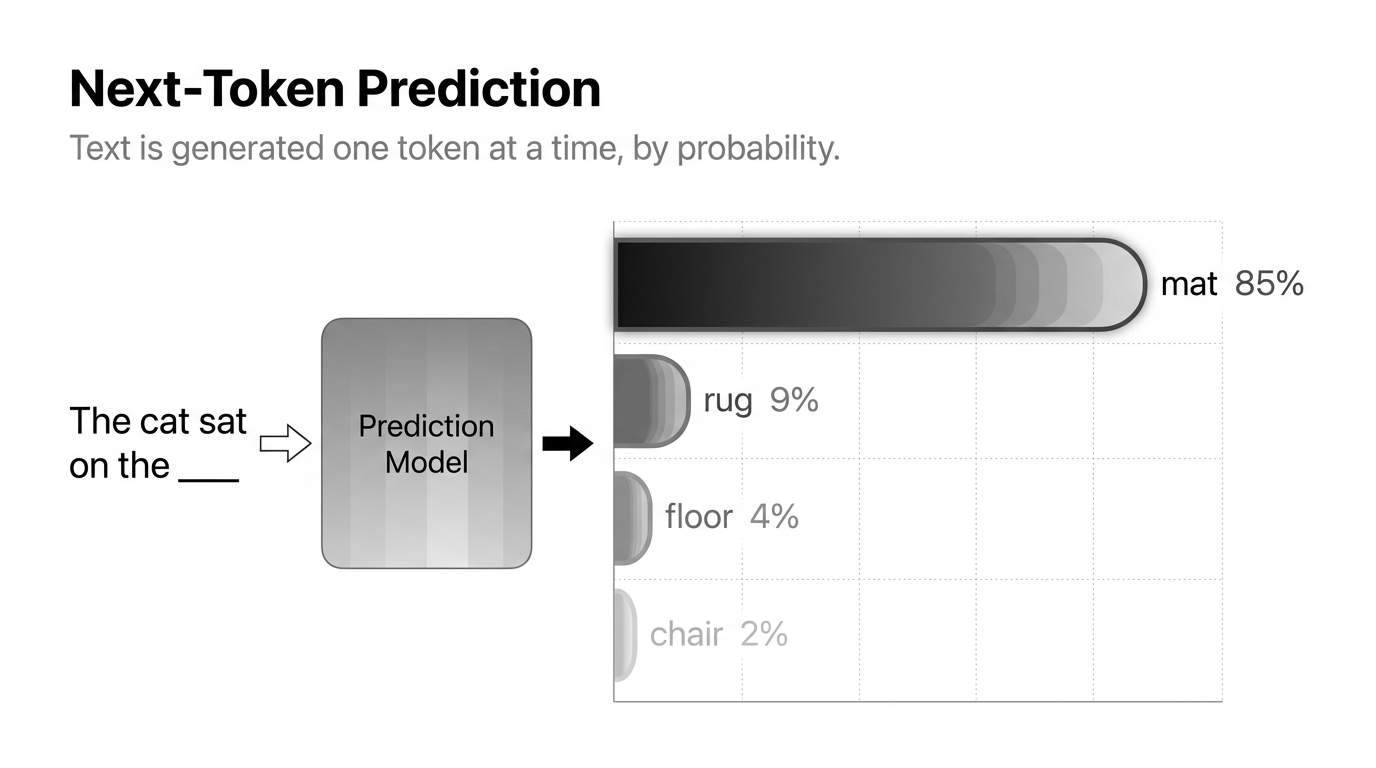
Because it predicts instead of looking up answers in a database, a language model usually generates new combinations of text rather than simply recalling stored information. That said, models can sometimes reproduce memorized training text, so "new" is not guaranteed.
A separate issue is hallucination: when a model confidently produces something plausible but false or unsupported. This matters because the same mechanism that makes AI useful for creative work also means you should verify factual claims.
Another thing you have to understand about AI is that it's still a bit of a black box. We don't fully understand how it generates what it generates, the decisions it makes and why, even though interpretability research is making progress. In everyday use, we mostly observe what it gives us when prompted.
Which brings me to the next important concept when working with AI, the prompt. The questions you ask and the statements you make are called prompts. And knowing how to formulate those questions and make those statements to it is the key for getting the most out of AI.
Now what makes a good prompt? This is a field of study on its own, and best practices are still evolving. But one thing is clear: AI can give different results depending on the wording, structure, format, and context you provide. Strange quirks like emotional framing or promises of a reward can affect results in some cases, but they are not reliable accuracy boosters. Clear context, clear constraints, and a natural conversational style are usually more useful.
Now that you know the basics of it let's get into an example of how to use it. Imagine you want to turn messy meeting notes into a clear follow-up email, here is how you would interact with ChatGPT for example.
Step 1: When starting a new chat in ChatGPT or another AI assistant begin by giving it a personality.
# WHO YOU ARE
You are a clear and practical writing assistant who turns rough notes into useful business communication.
Step 2: Give it a task. Describe what you want it to do.
# WHAT YOU DO
You help me turn rough meeting notes into a concise follow-up email.
You ask clarifying questions if something important is missing.
Step 3: Give restrictions. Adding restrictions enhances the creative result.
# RESTRICTIONS
Keep the tone friendly, professional, and direct.
Do not invent facts. If something is unclear, mark it as an assumption.
Keep the email under 180 words.
Step 4: Give it another task.
# WHAT TO DO NEXT
After the email, create an action list with:
- task: what needs to happen.
- owner: who is responsible, if the notes say so.
- deadline: when it is due, if the notes include one.
- priority: low, medium, or high.
- open questions: anything that still needs clarification.
This is a good example of how you might interact with ChatGPT to get the best results.
I hope you enjoyed this article. I had fun writing it. In the next topic I'll be delving deeper into AI agents, what they are and what they can do.
Until then,
Stefan